Final presentation and feedback
Presentation Date: 12. Nov. 2024
Last presentation I mentioned that the biggest feature of this film is how it presents the same story in three loops, showing how different ways of unfolding events impact the final outcome.
Just like these three images, the same two cars make different relationships across the three timelines, affecting each of their respective timelines.
The image below shows the timelines in the movie. Only after the entire story has unfolded once does it move to the next loop. At the same time, the events of the previous story bring experience into the next loop, causing different outcomes for the same events.
When I translated the film into an interactive hypertext story, the timeline changed; it’s no longer linear.
I transformed the three loops into parallel tracks. When readers view my adaptation, they can cross-select events between different loops and create a new storyline.
The original film only has three storylines, but by blending timelines, I can create a complex web of relationships.
At last I made a nonlinear hypertext story.
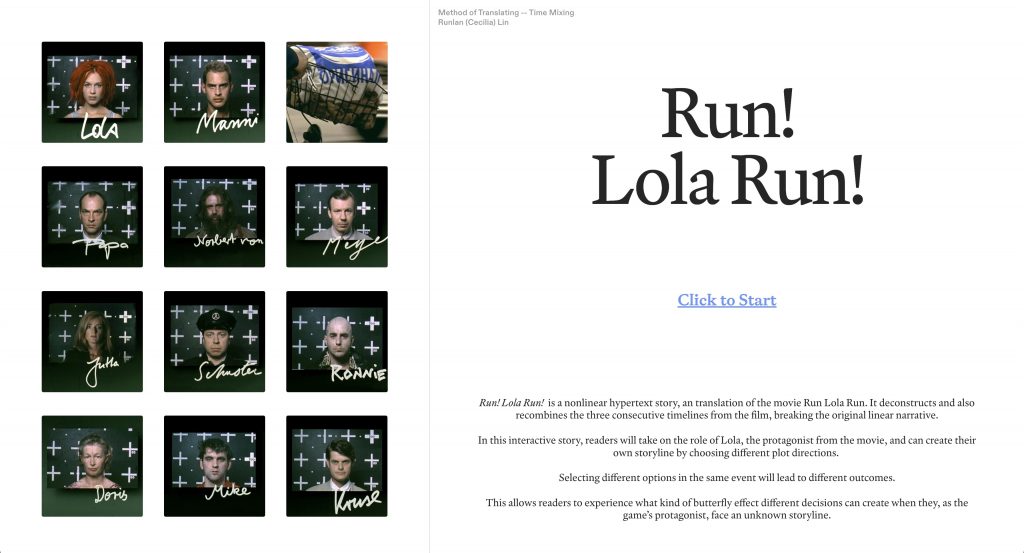
https://translolau1b3.cargo.site/
Click to Try the Story
The image above shows the full network of relationships for this interactive story.
In this hypertext story, readers will take on the role of Lola, the protagonist from the movie, and can create their own storyline by choosing different plot directions.
Selecting different options in the same event will lead to different outcomes.
This allows readers to experience what kind of butterfly effect different decisions can create when they, as the game’s protagonist, face an unknown storyline.
Feedback
Working well
Not working well
- Making it a website similarly reflects the series of links. This approach to the movie is really interesting. The web is interactive, so it allows you to show footage, and allows a degree of interactivity from the user.
- The fact that it is an unseen website structure makes the suspenseful part of the movie come alive.
- Type hierarchy, a little flat, a bit linear.
- It feels a bit too default. Try understanding what the content is and what you’re trying to do with it.
- A little “talk too much”. Making the user concentrate on the story more.
Further Development
- The typographic treatments (like the first page, images in set with the text, that’s really nice.)
- Explore typographic hierarchy (having bigger text, smaller text?), it should feel more dynamic
- Visual exploration (What if there’s a grid on the game background? Similarly to the code page map.)
- Countdown on pages while playing the game, run through the website (kind of add a sense of urgency)
- Translating the movie into an activity based game
Leave a Reply